Submission to the Royal Commission on Antisemitism and Social Cohesion
At the age of 71, one of the greatest shocks of my adult life has been the hostile views expressed and actions taken by so many people I know from the feminist, LGBT+, media and arts communities towards Australian Jewish people since the attack by Hamas on residents of southern Israel on October 7 2023.
What has shocked me the most is the openly expressed lack of empathy by many non-Jewish people toward the women and men in Israel who were sexually assaulted on October 7 and subsequently assaulted, including sexually, as hostages. This lack of empathy has also been expressed publicly towards Jewish women here in Australia who have spoken up in social or mainstream media about their growing distress and bewilderment at the increasing acts of verbal and physical violence towards Jewish adults, children and community organisations across Australia.
As a non-Jewish woman with several life-long friendships with Jewish Australian women with whom I went to high school and university in Sydney in the 1960s and 1970s – all of whom were the children of Holocaust survivors from Eastern Europe – I have been deeply disturbed by the growing fear among my Jewish friends that Australia is no longer safe for Jews. These fears kept intensifying and were confirmed by the horror of the deaths and injuries at the Bondi Beach attack.
Yet even after Bondi, non-Jewish women I have known for years in the progressive sectors of the feminist, LGBT+, media and arts communities continue to demonstrate a lack of empathy or concern for the safety and fears of Jewish women and their families in Australia. The only exception to this is when Jewish Australians express a comprehensive rejection of the views of the long-standing, representative Jewish community organisations in Australia. These Jewish women and men are acceptable.
It hasn’t only been the lack of empathy towards Australian Jewish women that I have witnessed since the October 7 attacks. It is also an unwillingness among non-Jewish, university-educated, progressive women in the LGBT+, feminist, media and arts communities to inform themselves about the history and drivers of antisemitism here in Australia. Since October 7, I have posted many articles across social media, including to the 6,000 plus followers I have on the professional site LinkedIn, about many aspects of antisemitism and its rising incidence in Australia and globally.
The articles I have posted have offered diverse points of view and have been from credible academic and media sources. Some of the written responses I have received, especially on Facebook, have been so hostile and personally vituperative, that for the first time in my life I have had to block people on social media. What has astounded me is that women I have known for decades, and who have been fellow social activists in the Gay Liberation, Women’s Liberation and Aboriginal Land Rights movements since the 1970s, have been among the most hostile and abusive in their comments about me on social media. This has included several retired senior academics from Australian universities.
After October 7, I travelled from Adelaide to march with the Jewish LGBTQ+ community organisation Dayenu at one of the Sydney Gay and Lesbian Mardi Gras parades. I wanted to show my support for Australian Jewish lesbians and other Jewish members of the Rainbow Jewish community in the aftermath of October 7.
Sections of the LGBT+ community were seeking to exclude Jews from marching in the parade. Jewish marchers have been welcome at Mardi Gras for years. It was devastating to observe the extra security that was organised by Dayenu, with support from Sydney Mardi Gras, to seek to keep Jewish marchers and their allies safe.
I became active in Gay Liberation, as it was originally called, in the early 1970s. I am a member of the community of early activists known as the 78ers. It was heartbreaking to witness the legitimate fear Jewish LGBT+ people were feeling as they walked on the streets of Sydney at a progressive celebration of LGBT+ people. It was a fear of violence but also of rejection and hostility.
In August 2025, I published on YouTube an interview I recorded about the Australian book, Ruptured: Jewish Women in Australia Reflect on Life Post October 7, published by Lamm Jewish Library of Australia on 1 August 2025. I interviewed the co-editors, Lee Kofman and Tamar Paluch and one of the 36 Australian Jewish women contributors, Ramona Koval, a former fellow radio broadcaster from ABC Radio National whose extensive media career focused on Australian writers and cultural themes. To date, this interview has been viewed over 8,000 times.
In November 2025, I moderated an on-line webinar for the National Council of Jewish Women of Australia about Ruptured interviewing the co-editors, Lee Kofman and Tamar Paluch and two more contributors to the book, including an experienced Melbourne feature writer and podcaster.
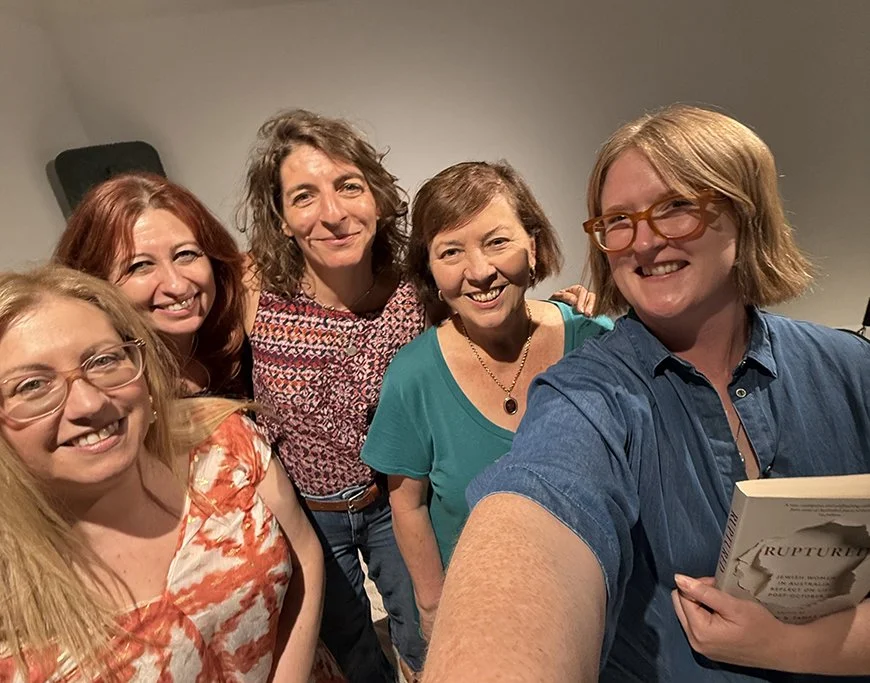
In March 2026 I launched Ruptured at the Adelaide Holocaust Museum and hosted a panel discussion with Tamar Paluch and two further contributors to the book, including a Jewish woman who heads a human rights organisation.
My engagement with multiple Australian Jewish women, who have written about their experiences of antisemitism in Australia in the book Ruptured, plus my connections with the multicultural and multifaith readers of the book on-line and at the Adelaide launch, have deepened my understanding of the degree of trauma Australian Jewish women are experiencing.
They report their distress is especially due to the silence, lack of support and breakdown of relationships with many non-Jewish friends and professional colleagues. A particular concern is their fear for the future safety of their children and grandchildren here in Australia. Like so many of their ancestors, do they need to flee to another country? And if so, where is safe in the world right now?
My deepest hope is that the Royal Commission on Antisemitism and Social Cohesion will provide a focus for action to nurture the community values, inclusive attitudes and tolerant behaviours that made Australia a haven and a land of opportunity for so many Jewish people fleeing the Holocaust after World War Two. The Australian community has been immeasurably enriched by the contribution of Jewish women and men in the arts, sciences, law, healthcare, education, business, philanthropy and beyond.
However, history tells us, once allowed to flourish, the ancient hatred of antisemitism is mightily hard to contain.
Reluctantly, I will share a story that illustrates the depth of the challenge we face in Australia. It is a story that chilled me to the bone because it illustrates for me the personal impact of antisemitism and how it distorts empathy, judgement and personal relationships.
After October 7, a long-term Jewish friend of mine, the daughter of Eastern European Holocaust survivors who emigrated to Australia after the war, was visited by a mutual non-Jewish friend who had been a senior journalist and journalism academic at a major Australian university. During the visit he spoke about why he was sympathetic, even supportive, of the attack by Hamas on October 7. This academic had been a guest in my friend’s home on a number of occasions at gatherings that included other Jewish people. Clearly Australian universities, especially faculties in the social sciences, arts and media, have problems that the Royal Commission will hopefully address. However, it was the willingness to bring advocacy for the views and sexually violent actions of Hamas into the home of a Jewish woman considered to be a friend that frightened me.
Through my high school friendships with Jewish girls, I met a wide circle of their parents, family and friends who had experienced non-Jewish neighbours turning on them, or remaining silent, during the Holocaust in Poland and other European countries. In Sydney, in the 1960s, not far from Bondi, I met Jewish people with numbers tattooed on their arms who knew that the moral command of the Abrahamic faiths to “love your neighbour” can shatter like glass very quickly.
May we all actively support all efforts to stop this trend intensifying here in Australia.
Ruptured : Jewish Women in Australia Reflect on Life Post-October 7
https://youtu.be/eZTcCJvpzfo?si=P4Hj4qRTGSHzn9MJ
Ruptured: NCJWA Women’s Voices Webinar
https://youtu.be/e-aF0x5p_vg?si=oakEUNO2mz-SYklQ
Submission to the Royal Commission on Antisemitism and Social Cohesion.
Julie McCrossin AM