Reflections on Antisemitism in Australia and What to Do Right Now
After the October 7 2023 attacks by Hamas in Israel, I saw posters with photos of hostages taken by Hamas that were ripped and graffitied with negative comments at the University of Sydney and the University of Melbourne. Some of these damaged posters showed photos of small children taken into Gaza. I was shocked and frightened for my country.
After the Holocaust, Australia was a refuge for many Jewish survivors who came here to build a new life after World War Two. A group of Jewish girls were in my high school classes in the 1960s and early 1970s at SCEGGS Darlinghurst in Sydney. These classmates were the daughters of Holocaust survivors. I heard many stories first hand from their parents from countries like Poland. They told me stories of survival: how people escaped the ghetto, or jumped out of a train carriage and hid in the forest, or managed to “pass” as a non-Jew during the war in Warsaw, on false papers, while living in fear of being betrayed to the Gestapo. Some of the adults I met had numbers tattooed on their arms. Parents told me how grateful they were to be in Australia and how wonderful it was to be so far from Europe. I developed a life-long interest in antisemitism as I struggled to understand why these fine people had lost so many family members during the murderous horrors of the Shoah.
After the October 7, it is heartbreaking to me that the children, grandchildren and great grandchildren of these Holocaust survivors no longer feel welcome or safe in Australia. I am particularly concerned about Australian Jewish children, teenagers and young adults who are faced with sustained antisemitic misinformation and imagery in mainstream and social media. They are dealing with media reports of violence towards Jewish people and property within Australia. To cite a particularly disturbing example, the burning of synagogues in Melbourne has sent shock waves through Jewish families. Synagogues with people inside have been set alight for centuries by antisemitic mobs. It is a horror we never expected to see here in Australia. It ignites intergenerational trauma. I have visited the site of a synagogue set alight with people inside in Bedzin, Poland with my Jewish school friend Sophie and her mother Irene, a survivor of the Warsaw Ghetto, who grew up in Bedzin. Many Jewish Australians will have similar family stories.
Burning of the Great Synagogue in Bedzin Based on Witness Accounts: http://www.ilikezaglebie.pl/en/spalenie-bedzinskiej-synagogi-relacjach-swiadkow/
What can we do to show care and respect towards Jewish Australians and create educational opportunities for non-Jewish Australians who are willing to listen? It is not enough to feel concern. Concern alone changes nothing. We need to act.
Here are examples of action I shared at a recent rally at Parliament House in Canberra, Australians Against Antisemitism, hosted by Never Again is Now.
“Ruptured: Jewish Women in Australia Reflect on Life Post October 7” is a collection of essays by Australian Jewish women published this year by Lamm Jewish Library of Australia. Read this book and share it widely. It is a real-time historical record of the Australian experience of antisemitism and how it disrupts relationships. The co-editors of the collection, Lee Kofman and Tamar Paluch have been interviewed for podcasts by myself, with nearly 8,000 views so far, and Dr Mike Kelly AM, who also spoke in Canberra. Let’s work together to attract as big an audience as possible for these moving accounts of what “antisemitism” looks like here in Australia and why action to address it is so important.
Showing care and respect for Jewish school and university students is a special priority. Young people are so vulnerable to attacks on their identity.
On the school front, here are some suggestions from Jenny Allum, Head of School at SCEGGS Darlinghurst. We need to encourage teachers to ask Jewish students “How are you going? Are you ok? This must be a difficult time for you?” To show care for Jewish students is not to take a side in the Hamas-Israel conflict. Australian Jewish children, young people and adults are not responsible for a foreign war. We need to speak up in schools in clear language and say “We stand against antisemitism”.
In term three this year, Jenny Allum interviewed four students from different faiths during Chapel services at school. SCEGGS (Sydney Church of England Girls Grammar School) is an Anglican school. Christian services are a regular part of school life. The girls interviewed were from years seven, eight, eleven and twelve. They were from Hindu, Muslim, Buddhist and Jewish families. Each girl was asked the same three questions. “Tell us something about your faith that is special or different from what we do in Chapel? Tell us about a celebration or holiday in your faith? Is there something in your religion that could make the world a kinder, better place?” This series of interviews was a brilliant practical way to show care and respect to Jewish students at this challenging time, while including students of other faiths and providing interfaith education.
Schools and universities have many on-line and hard copy newsletters and magazines. These provide opportunities to counter antisemitism with factual information. The October 2025 issue of a SCEGGS newsletter features an article about the Sydney Jewish Museum in Darlinghurst. Like many other schools, this museum is an educational resource for SCEGGS students. The article includes a photo of the late Eddie Jaku, a Holocaust survivor and author of the best-selling memoir, “The Happiest Man on Earth” about his experiences in multiple death camps and his survival. Eddie Jaku is the great grandfather of a SCEGGS student. This newsletter has a distribution of over 7,500 members of the school community, past and present.
Collaboration between faith groups and organisations is an effective way to address antisemitism and nurture social cohesion.
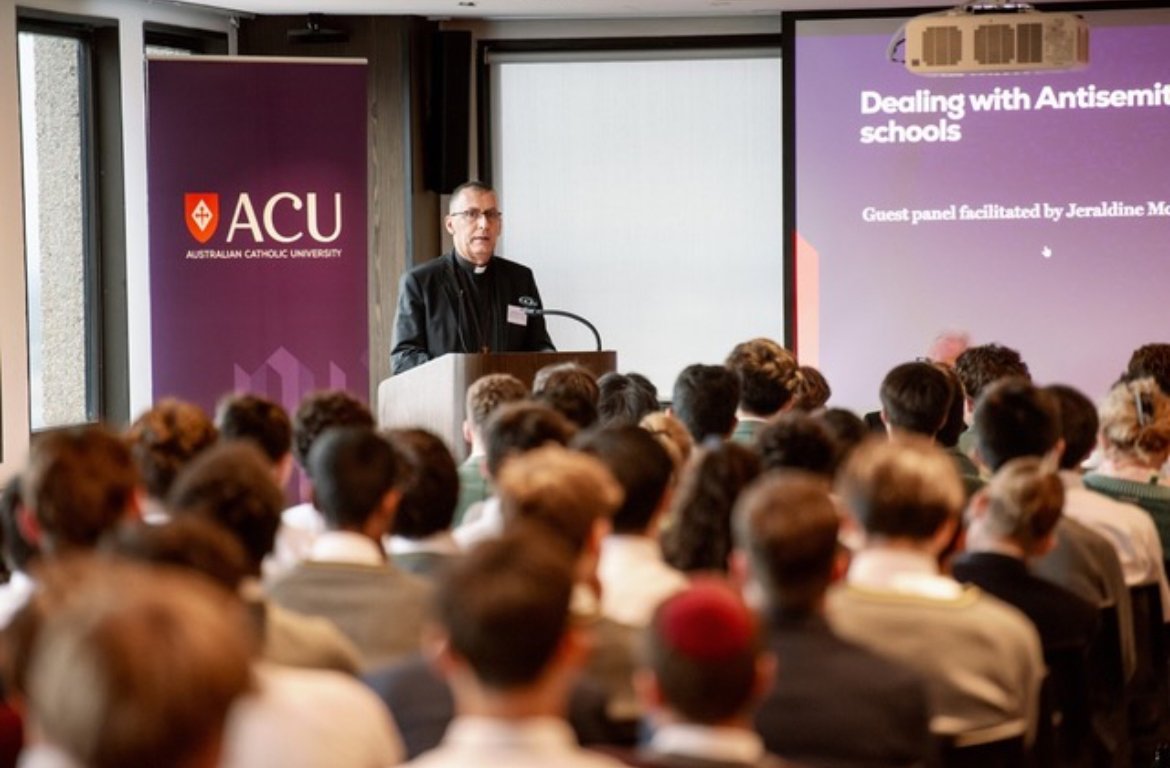
On October 28 this year Catholic Schools NSW, the Executive Council of Australian Jewry and the Australian Catholic University hosted the Nostra Aetate Countering Antisemitism Forum. It was held on the 60th anniversary of the historic Vatican statement on the relationship of the Catholic church to Jewish people and people of other non-Christian faiths. The forum was attended by 125 students from 15 Catholic and Jewish secondary schools. Teachers attended as well. Students were able to ask anonymous questions that were answered by Jewish and Catholic community and faith leaders.
The Australian Jewish News reported that student questions included “if it was possible to be pro-Jewish but anti-Israel, how to define anti-Zionism and antisemitism, the impact of social media on the rise of antisemitism, what elements of interfaith discourse have been avoided since 7 October, 2023, and the Catholic Church’s position on Israel.” The Australian Catholic University will develop digital resources to combat antisemitism in Catholic schools that will be informed by these student discussions.
Catholic organisations are showing admirable leadership in collaborative work with Jewish organisations. Addressing Antisemitic Bullying is a resource developed by Catholic Religious Australia and the Executive Council of Australian Jewry. It is an on-line resource for schools with videos, PowerPoint presentations and discussion guides. It has practical suggestions for responding to antisemitic bullying.
https://www.catholicreligious.org.au/addressing-antisemitic-bullying
The USA Catholic Bishops have published 16 facts sheets for schools to help students understand Judaism. They have also produced a resource called Translate Hate: The Catholic Edition. It is a catalogue of anti-Jewish stereotypes still found in Christian bible commentaries and sermons with the Catholic view on what is wrong with these stereotypes. Similar resources have been published by the Catholic Church in France and Italy. Translate Hate: The Catholic Edition https://www.usccb.org/resources/translate-hate-catholic-edition
My focus here is on addressing antisemitism in Australia. I oppose racism and attacks against people of all cultural backgrounds and faiths. Right now in Australia the rise in anti-Jewish attitudes are of particular intensity and concern among young Australians.
Seven years ago I visited the non-Jewish Australian daughter of an old friend at a college at Oxford University in the UK. That evening I attended the Church of England Evensong service in the medieval college chapel. The music was as glorious as I hoped. The erudite sermon was given by a female Progressive Jewish Rabbi invited up from London. My question is this: would this be possible in any Australian university in 2025 without significant demonstrations and security concerns?